Cross posted from the Google Cloud Platform Blog
Everything at Google, from Search to Gmail, is packaged and run in a Linux container. Each week we launch more than 2 billion container instances across our global data centers, and the power of containers has enabled both more reliable services and higher, more-efficient scalability. Now we’re taking another step toward making those capabilities available to developers everywhere.
Support for Docker images in Google App Engine
Last month we released improved Docker image support in Compute Engine. Today, we’re building on that work and adding a set of extensions that allow App Engine developers to build and deploy Docker images in Managed VMs. Developers can use these extensions to easily access the large and growing library of Docker images, and the Docker community can easily deploy containers into a completely managed environment with access to services such as Cloud Datastore. If you want to try it, sign up via this form.
Kubernetes—an open source container manager
Based on our experience running Linux containers within Google, we know how important it is to be able to efficiently schedule containers at Internet scale. We use Omega within Google, but many developers have more modest needs. To that end, we’re announcing Kubernetes, a lean yet powerful open-source container manager that deploys containers into a fleet of machines, provides health management and replication capabilities, and makes it easy for containers to connect to one another and the outside world. (For the curious, Kubernetes (koo-ber-nay'-tace) is Greek for “helmsman” of a ship.) Kubernetes was developed from the outset to be an extensible, community-supported project. Take a look at the source and documentation on GitHub and let us know what you think via our mailing list. We’ll continue to build out the feature set, while collaborating with the Docker community to incorporate the best ideas from Kubernetes into Docker.
Container stack improvements
We’ve released an open-source tool called cAdvisor that enables fine-grain statistics on resource usage for containers. It tracks both instantaneous and historical stats for a wide variety of resources, handles nested containers, and supports both LMCTFY and Docker’s libcontainer. It’s written in Go with the hope that we can move some of these tools into libcontainer directly if people find them useful (as we have).
A commitment to open container standards
Finally, I'm happy that I've been nominated to Docker's Governance Committee to continue working with the Docker community toward better open container standards. Containers have been a great building block for Google and by working together we can make them the key building block for “cloud native” applications.
-Posted by Eric Brewer, VP of Infrastructure
Showing posts with label app engine. Show all posts
Showing posts with label app engine. Show all posts
Wednesday, 11 June 2014
Monday, 11 June 2012
Google Ideas develops citizen engagement pilot project for Somalia
When a country is unable to hold regular elections, how do people make their voices heard? That’s the challenge today in Somalia, which hasn’t had a permanent government since 1991. Somalia is in the middle of drafting a new provisional constitution which will be ratified later this summer, and with this process has come new opportunities to increase citizen engagement.
As the draft constitution has undergone revisions in recent months, Google Ideas developed a pilot project with the Somali service, Africa Division of Voice of America (VOA) to help Somalis register their opinions. Using Google App Engine, Google Voice, and Google Docs, we built an internal site for VOA to conduct public opinion polling:
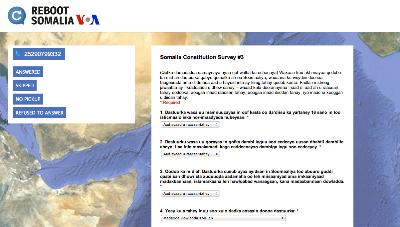
Starting in April, with just a few clicks, VOA pollsters could call and survey Somalis for their thoughts on a new constitution, asking questions such as: Should there be a strong central government? Should Sharia law be the basis of the constitution? And should there be a requirement that women be included as elected officials? Over three rounds of polling, VOA used the internal site to collect the survey results. The last round concluded last week, and VOA published the aggregate results across the country on its new radio program, “Constitution Square.”

We’re pleased to make this small contribution in helping Somalis participate as they draft a new constitution, and hope that others might benefit from this as well. This open source project can be modified for use in any country or context, and anyone interested in downloading the source code can click here.
By Brendan Ballou and Yasmin Dolatabadi, Google Ideas
As the draft constitution has undergone revisions in recent months, Google Ideas developed a pilot project with the Somali service, Africa Division of Voice of America (VOA) to help Somalis register their opinions. Using Google App Engine, Google Voice, and Google Docs, we built an internal site for VOA to conduct public opinion polling:

Starting in April, with just a few clicks, VOA pollsters could call and survey Somalis for their thoughts on a new constitution, asking questions such as: Should there be a strong central government? Should Sharia law be the basis of the constitution? And should there be a requirement that women be included as elected officials? Over three rounds of polling, VOA used the internal site to collect the survey results. The last round concluded last week, and VOA published the aggregate results across the country on its new radio program, “Constitution Square.”

We’re pleased to make this small contribution in helping Somalis participate as they draft a new constitution, and hope that others might benefit from this as well. This open source project can be modified for use in any country or context, and anyone interested in downloading the source code can click here.
By Brendan Ballou and Yasmin Dolatabadi, Google Ideas

Friday, 24 February 2012
Open Monitor: Building a World Wide Internet Connectivity Monitor through Google Summer of Code 2011

Despite all the magnificent improvements to both technology and the internet these days, we lack a free and open source real time internet connectivity monitor from which anyone can tell what the connectivity conditions are in any part of the world. Solving this problem is a huge undertaking, but at Umit Project, we saw a chance to start developing such a solution through the Google Summer of Code when we were chosen as a mentoring organization for the 2011 program.
We chose a hybrid P2P approach that would consist of hybrid peers and a centralized server that we call the aggregator. The hybrid peers would be able to communicate with each other and pass along reports even if direct connection to the aggregator is blocked, acting as both a server and client and promoting themselves to super peers as needed. The aggregator would be responsible for gathering all the connectivity reports from the peers and showing them in real time in a Google App Engine based site using the Google Maps API.
We also thought of having three different kinds of peers: desktop peer, desktop super peer and mobile peer. The desktop peer runs on top of the same code base but promotion to super peer status is based on the peer's availability. The desktop version is very portable (runs on Mac, Linux and Windows) and is written in Python, while the mobile peer is Android based, can not turn into a super peer and is focused on getting us a view from inside mobile ISPs.
We were given three talented students for the three month long Google Summer of Code, and each of them tackled the different pieces of the system. Despite the overwhelming amount of work and the short time frame they were working with, the students managed to get these systems to form a network, communicate, run connectivity tests and share reports.

The Umit Project team has been working very hard since Google Summer of Code ended in August to deliver our first version of Open Monitor and we're very close to releasing an alpha in the next few weeks for selected trusted testers.
If you're interested in knowing more about the project, its motivation, and more technical details about it, we have released a video on YouTube of a presentation given about the project at the Creativity World Forum 2011 and another talk given at the Chicago Python User Group Meeting. Slides of the CWF11 presentation are also available to view.
Special thanks to Google for their amazing Google Summer of Code program!
By Adriano Marques, Director of Umit Project and Google Summer of Code mentor
Wednesday, 22 February 2012
Cauliflower Vest: end-to-end OS X FileVault 2 recovery key escrow solution
We are thrilled to announce the open source release of Cauliflower Vest, a solution that we’ve developed to automate enabling FileVault 2 and escrowing recovery tokens.
FileVault 2 is a major, welcome addition to Mac OS X starting with Lion, as full disk encryption is an important part of securing your computer and its data. While the new FileVault 2 offering is very well suited to consumers, some enterprises may require additional features that are not provided out of the box. For example, FileVault 2 encryption is initiated voluntarily by users, lacks enforcement, and, by default, escrows recovery keys to Apple’s central server. It also relies on individual Apple IDs, which cannot be managed as a group.
Cauliflower Vest bridges these feature gaps by allowing enterprise Mac admins to:
- Forcibly enable FileVault 2 encryption.
- Automatically escrow recovery keys to a secure Google App Engine server.
- Securely access recovery keys so that volumes may be unlocked or reverted.
This release includes a GUI client to easily enable encryption, an escrow service, and a web UI for management. Also provided is a standalone CLI tool to automatically initiate encryption and generate a recovery key without requiring any user actions.

Employees at Google self-enable FileVault 2 using Cauliflower Vest - it’s tested and ready to help you make FileVault 2 part of your enterprise.
We are releasing this source code today as part of our commitment to share Google's unique IT approach with the world, including future releases of Simian and more.

Several Googlers made Cauliflower Vest possible: Anthony Lieuallen, Avi Drissman, Edward Marczak, Felix Gröbert, Greg Castle, John Randolph, Justin McWilliams, and Mark Mentovai.
By Edward Marczak, John Randolph and Justin McWilliams, Google Corporate Platforms Engineering Team
Subscribe to:
Posts (Atom)